


Table of Contents
The good stuff
- It has great motor power and assistance
- Well-balanced and grippy
- The extended battery addition is great
Some potential improvements
- Secondary battery design for hassle free extraction
- Add a more ergonomic saddle
- Reduce the walk-assist maximum speed
-
Motor assistance & PAS
-
Battery range
-
Overall Weight
-
Responsiveness & Comfort
-
Accessories
-
Technology combo
-
Warranty
The Rilu Pogo is a fat-tyre step-thru folding electric bike, built for fun rides on any terrain in urban / beach settings.
Rilu E-Bikes loaned this electric bike for testing purposes, and the words are my own. I’m not being compensated to create this review
Pogo Specs Summary (basic)
| E-BIKE MODEL: 2023
PURPOSE: City, Medium-Level Gravel Rides and Beach settings MOTOR & TOP SPEED
|
BATTERY
|
RANGE (based on brand information)
|
CONTROLLER, RIDING MODES, & DISPLAY
|
FRAME
|
GEAR SYSTEM
|
BRAKING SYSTEM
|
RILU POGO ELECTRIC BIKE WEIGHT
|
| TYRES & SUSPENSION Tyres:
Suspension:
|
SENSORS
|
FEATURES
|
PRICE & WARRANTY
|
Rilu Pogo Review: My Findings
Terrains tested
I tested the Pogo on:
- A medium dense and very loose gravel flat terrain to test maneuverability, tyre grip, and responsiveness.
- Hard ground with both uphill (about a 30% incline) and downhill sections to test the motor and brake performance.
- I rode into much harsher ground involving tree roots and gutters.
The above were also tested with deflated tyres to experience the difference in performance.
First impressions
- The first time I looked at it, it gave me a sense of sturdiness and fun. It also made me worried about the weight because of its bulkiness.
- When holding and lifting (slightly) the bike, it felt heavy; however, I noticed it came with two batteries. I wonder why?
- I really liked how clean and smooth the aluminium frame and other components looked.
Test Ride: Speed Levels (SL)
As found in other Rilu e-bike reviews, the fat-tyre model also offered a speed level (SL) configuration.
Compared with the chart below, the SL was capped almost as indicated, including the maximum SL9. In this instance, the motor cutoff was set at 25 km/h, as mandated by the electric bike law in Victoria. This speed would also be fine in NSW.
Read my article if you want to find out more about e-bike laws.
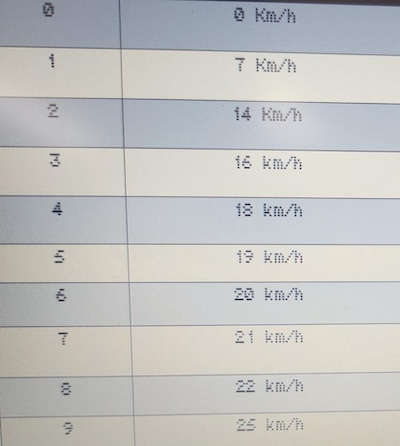
No motor assistance
- Considering the Pogo looked sturdy and big, an important test was how to ride it without assistance. I tested it on flat ground to set a baseline. What I experienced was a heavy electric bike.
- When riding on a slight incline, I immediately had to play with the shifts and pedal hard.
I think the Pogo is too heavy to ride without motor assistance, but it can be manageable in the worst case.
Speed Level 1
- The SL1 was a surprise. I was expecting low support, but it pushed nicely, allowing me to cruise on flat terrain.
- On a gentle hill, it lacked a bit of power, but it was not too bad considering its overall weight of 33 kg (with the two batteries embedded).
Speed Level 5
- The SL5 was another surprise, delivering much more power (I could probably compare it to riding the Rilu Onyx with the SL9).
- The motor cruised on flat terrain and didn’t struggle on a gentle incline.
Speed Level 9
- The SL9 was obviously really supportive, which gave me confidence when riding hills and carrying a lot of weight.
- One thing I noted was the slight difference between SL5 and SL9 in the support provided. They felt almost the same.
Overall, I didn’t detect a big difference between SL5 and SL9. I believe that SL9 would be best used for steep hills, SL5 for gentle hills, and SL1 for flat, cruising terrain. As for a beach adventure, I’d say SL5 is perfect.

Test Ride: Comfort and Ride Feel
- One of the most comfortable things when riding an electric bike is the ability to hop in and out quickly. And this is what I experienced with this step-thru frame.
- Similar to what was presented with the Rilu Nomad folding e-bike, the handlebar was also easily adjustable. In this case, it was easy to find a good body posture during my ride.
- Although it is not an obvious feature, it also has a seatpost with 15mm of shock absorption. Combined with the fat tyres, most obstacles along my ride felt soft, like I was riding an e-mountain bike.
All of the above findings made my ride enjoyable; however, after a 40-minute continuous ride, my hips felt fatigued. The main reason I found was the saddle design, which was not too ergonomic – something that can be upgraded by the user.
Test Ride: The Fat-Tyres Performance
Fully inflated tyres
The fat tyres of the Rilu Pogo have a pressure range of 5 to 30 psi. Most of my tests were conducted at 30 psi. I clearly noticed that the rolling performance was good at this pressure; however, the grip on loose gravel felt just okay.
Deflated tyres
When dropping the pressure to 15 psi, many things felt different: grip increased, cornering control on loose gravel improved, and bumps on the terrain were almost nonexistent.
The only thing that made me slow down on the corners was the sensation of the Pogo losing support, which I think was the combination of high weight and low tyre pressure.
Overall, I think keeping the tyre pressure at 30 psi is best when carrying a lot of weight and riding at low speeds, and at a lower pressure (no less than 15 psi) when more grip is needed, like at the beach.
The Controller & Display Features
The controller is a basic unit with a big LCD for all important readouts. As mentioned in other Rilu reviews, I like that it is a simple unit and easy to operate.
Error messages
A feature I appreciate is the possibility to see real-time error codes on the go (no smartphone or apps needed).
Tip: Read the brand-provided manual for more information about the codes.
Pogo walk-assist mode test
This mode is very handy, especially when pushing the 33 kg weight.
- The first test was using the throttle feature. This throttle gave me 6 km/h, which was too fast for me.
- The second test involved using the walk-assist feature (press and hold the “M” and “-” controller buttons simultaneously for 3 seconds). It took off gently, but it quickly reached about 5 km/h, which was too fast for me still.
This feature is great for hauling the Pogo uphill, but it could be adjusted for a safer walk.
The Throttle Feature
A very important topic in Australia, especially in Victoria, with such restrictive (but safe) electric bike laws.
- It comes with a single speed level: 6 km/h. It was great to help me gain momentum from a static position.
- The thumb-triggered version is better than a twist-and-go feature, and the trigger was big enough to fit my big thumb.
- Based on the Victorian e-bike regulation, the throttle should be used if: 6km/h maximum assistance, and the motor is below 250W continuous power. So far, it complies.
Pogo Folding & Unfolding Experience
- This was my first time folding a fat-tyre e-bike. Luckily, I had some experience already from other models from the same brand. As a result, the folding was straightforward.
- The unfolding process was also simple; however, I faced some challenges. The difficult part was keeping the two frame pieces together until the lock was latched.
The main reason the unfolding (and part of the folding) process was challenging was that I couldn’t remove the secondary battery. This battery made the Pogo really heavy, and folding/unfolding the frame required lifting the bike for a bit.
Things I Loved About the Pogo
1. Enhanced comfort: not only the front and the seatpost suspension added to a joyful ride, but also the tyres were a key element to my overall ride, especially when tackling roots, small rocks and bumps along gravel paths.
2. The second battery as a backup: the main battery provided around 40km range, which is not too bad for a big e-bike; the good thing was that the backup battery allowed me another 40km more range, which was a relief to avoid riding it as a standard bike.
3. Power of the motor: Although this e-bike is heavy, I was impressed by how the motor provided so much power and torque, especially when climbing challenging hills.
4. The throttle feature: a couple of things I loved about it:
- This feature was set to comply with the Victorian e-bike regulations.
- It was a blessing when taking off from a static position after forgetting to change my gear.
Overall, I was having fun and not worrying about the terrain I was riding on.
The Potential Deal-Breaker?
The Pogo gave me a really good experience when riding on different terrains. Not everything was perfect; these are some potential deal-breakers:
- Its weight. As mentioned before, the bike itself weighs around 27kg, and 33 kg with the two batteries in place.
- Although it is not a direct Rilu design issue, I couldn’t remove the secondary battery, which was frustrating.
- The saddle selected for the Pogo was not the most comfortable one, which I noted after 40 minutes of riding.
- Because of the Pogo’s weight, the folding/unfolding process was difficult (though it was straightforward process).

These are minor adjustments, especially the saddle.
Is the Rilu Pogo Worth It? Verdict
After two weeks of riding it on different terrains, I gained a good insight about this fat-tyre e-bike.
- Anyone wanting to have an off-road adventure, including riding along the beach and carrying some stuff, would benefit from it: it has reliable power, high torque and good traction when using deflated tyres;
- If the plan is to ride along city streets most of the time, I think there are other options that are better suited: lightweight, less bulky, and easier to fold if necessary.
The Rilu Pogo step-thru folding fat-tyre e-bike sits well within its category. To me, it offered high-quality components, it was grippy and well-balanced. The best part was I had a lot of fun while reviewing it.
Have you had any good or bad experiences riding this Rilu model? Please share your thoughts in the comments below.
