


An electric bike conversion kit can be an excellent solution for riders who want the benefits of an e-bike without replacing their standard bike.
Many cyclists already own a reliable bike that fits them well. Instead of replacing it, a conversion kit allows you to add electric assistance while keeping the bike you already love.
But an important question remains: are e-bike conversion kits actually worth it? The short answer is yes, as long as you choose the right kit and use it correctly.
In this guide, I’ll explain how they work, the different types available, their benefits and limitations, and what to look for before buying one.
Table of Contents
What Is An Electric Bike Conversion Kit?
An electric bike conversion kit is a set of components designed to transform a standard bicycle into a pedal-assist or throttle-powered electric bike.
READ MORE: Electric Bike Without Pedal Assist Guide? Throttle Vs PAS
Most kits typically include:
- A motor (hub or mid-drive)
- A battery pack
- A controller and display (usually basic versions)
- Pedal assist sensor (usually speed only)
- Wiring harness
Most kits provide all required components, while others only include the motor and controller, meaning the battery must be purchased separately. Well-known manufacturers (e.g., Orbea, Trek) don’t offer this alternative.
Some Options Available In The Market
Mid-drive e-bike kit type
A mid-drive electric bike conversion kit places the motor at the bike’s bottom bracket, where the crankset is located. The motor directly drives the crank and uses the bike’s gears to generate power.
|
Benefits
|
Limitations
|
Because the motor works through the drivetrain, mid-drive systems provide excellent climbing performance, making them ideal for riders who tackle steep terrain.
However, they can slightly alter the bike’s appearance and require more mechanical knowledge to install compared with hub kits.
Suggested mid-drive e-bike kits
As far as I can see, there are three (3) main manufacturers that I could suggest trying.
|
TongSheng 250W
|
✅ : It is lighter than any other mid-drive motor kit, and it includes a rear light to ride at night.
X: It does not include a battery. I recommend checking the motor voltage and watts for compatibility. |
|
TongSheng 500W
|
✅ : All elements are included (e.g., front and rear lights and battery (optional at an extra cost)) for an easy and smooth installation.
X: You will need to add a suitable rear rack to accommodate the battery. |
Bafang 250W  |
✅ : There are so many alternatives to choose from, so it is easy to find the most suitable alternative.
X: It may not be suitable for mountain biking as the ground clearance is low. X: Doesn’t include a battery. |


Hub motor e-bike kit type
The hub motor electric bike conversion kit is the most common and beginner-friendly option.
Instead of installing the motor in the drivetrain, the motor is integrated directly into a replacement wheel hub. Installation is simple: replace your existing wheel with the motorized one.
|
Benefits
|
Limitations
|
Suggested rear and front hub e-bike conversion kits
There are many options to look at, but I believe these two (2) are good:
|
BAFANG REAR KIT |
✅ : This kit contains all that is required for an easy installation, including two (2) battery options (rear rack or frame’s down-tube).
X: It may not align with many countries’ e-bike regulations about the maximum allowed power output. |
|
BAFANG FRONT KIT
|
✅ : Similar to the above, it has all the elements; however, it also offers a 3rd battery alternative for extended range.
X: It could be a little pricey for this type of technology. |


Friction Drive Bike Kit
A friction-drive electric bike conversion kit offers one of the simplest ways to electrify a bicycle.
Instead of replacing a wheel or crank system, these kits use a motorized roller that presses against the rear tire. When the throttle is activated, the roller spins, propelling the bike forward through friction.

|
Benefits
|
Limitations
|
Because of these limitations, friction drives are generally best suited for flat urban commuting rather than demanding terrain.
For now, I have nothing to suggest for the friction kit type.
Electric Bike Conversion Kit Types – Quick Comparison Table
| Conversion Kit Type | Installation Difficulty | Best For | Key Advantage | Main Limitation |
|---|---|---|---|---|
| Mid-drive kit | Moderate to difficult | Hills, mountain biking | High torque and efficient use of gears | More expensive |
| Hub motor kit | Easy | Commuting and flat terrain | Simple installation and affordability | Lower torque on steep climbs |
| Friction-drive kit | Very easy | Urban commuting | Cheapest and easiest installation | Lower efficiency and traction |
Benefits of Electric Bike Conversion Kits
Choosing an electric bike conversion kit offers several advantages compared with buying a new e-bike.
Costs
Many entry-level electric bikes start around $800, while decent mid-range models often cost $1,000–$2,500. High-end e-mountain bikes can easily exceed $6,000.
In comparison, many conversion kits range between $300 and $1,000, making them a far more affordable option.
Your standard bike
If you already own a comfortable or high-quality bicycle, converting it allows you to retain the geometry, fit, and components you prefer.
This is especially appealing for riders who already have a well-maintained bike frame. Keep in mind that not all standard bikes can fit a conversion kit.
What to Consider Before Buying an Electric Bike Conversion Kit
Before purchasing an electric bike conversion kit, it’s important to evaluate several key components.
The Motor
Motor power determines how much assistance the system can provide. Common power ratings include:
- 250W (typical legal limit in many countries)
- 500W
- 750W
- 1000W and above
For steep terrain, mid-drive motors or geared hub motors usually perform better.
Higher wattage provides stronger acceleration and better climbing ability, but always check local e-bike regulations before choosing a motor.
RECOMMENDED GUIDE TO READ: Electric Motor Bike Guide for Beginners.
The Battery
Three (3) factors related to the battery should be on your radar when shopping for an e-bike kit. They include:
- The type of battery chemistry (Li-ion vs. Ni-Cad).
- The battery’s capacity (Watt-hours) and
- How long can it retain a charge?
Higher capacity batteries deliver longer riding range, but they also increase the kit’s cost and weight.
Always ensure the battery voltage matches the motor requirements to avoid performance issues.
RECOMMEND TO READ: E-Bike Batteries: The Beginner’s Guide.
The kit’s built-in materials
Durability matters. Look for kits made with:
- Aluminum or reinforced alloy components
- Quality wiring connectors
- Durable spokes and rims
Higher-quality materials usually mean longer lifespan and fewer maintenance issues.
Warranty period – Important
A good electric bike conversion kit should include a warranty covering major components like motor, controller, and battery.
Many reputable manufacturers provide 1- to 2-year warranties, and some premium models offer longer coverage.
Electric Bike Conversion Kit Installation Checklist
Installing an electric bike conversion kit is manageable for many riders, especially when using hub motor kits. However, a few checks before starting the installation can save time and prevent compatibility problems.
Use this checklist before purchasing or installing your kit.
Frame and wheel compatibility
Before installing an electric bike conversion kit, confirm that your bike frame and wheels can accommodate the battery, the motor and its power.
Important points to verify include:
- Wheel size compatibility (26”, 27.5”, 700C, etc.)
- Rear or front dropout width
- Enough frame space for mounting the battery
- The cassette or freewheel system is compatible
- The spokes and rim are strong enough for the motor power
Not all frames, especially carbon fiber frames, are suitable for conversion kits.
Drive-train compatibility and condition
A conversion kit adds extra load to your drive-train. Before installation, inspect:
- Chain wear
- Cassette condition
- Chainring teeth
Replacing worn drive-train parts beforehand ensures the system operates smoothly.
Local e-bike regulations
Motor power and throttle usage is restricted depending on where you live.
Common limits include:
- 250W motors in many European and Asia-Pacific countries
- 500W–750W limits in parts of North America
- Speed limits between 25 km/h and 32 km/h
Always confirm local regulations before buying a kit.
Mistakes to Avoid When Installing a Conversion Kit
Installing an electric bike conversion kit is achievable for many riders, but certain mistakes can lead to poor performance or even damage to the system. Avoiding the following issues will help ensure a safe and reliable conversion.
Choosing the wrong motor power
One of the most common mistakes is selecting a motor that doesn’t match the rider’s needs or local regulations.
For example:
- 250W motors are usually sufficient for flat city commuting.
- 500W–750W motors perform better on hills or heavier bikes.
Installing a motor that exceeds legal limits could make the bike illegal for public road use.
Ignoring torque arms
Hub motors generate significant rotational force. Without a torque arm, the motor axle may damage the bike’s dropouts.
Torque arms reinforce the frame and prevent the motor from twisting out of position.
This small component can significantly improve the safety and longevity of the kit.
Installing an incompatible battery
The battery voltage must match the motor and controller specifications. For example, a 48V motor requires a 48V battery.
Using the wrong battery can cause underperformance, overheating, or controller damage.
Poor cable routing
Improper cable routing is a common issue during DIY installation.
Loose cables can:
- Rub against moving parts
- Interfere with steering
- Become damaged over time
Secure cables along the frame using zip ties or frame clips to keep the system neat and protected.
Underestimating added weight
Motors and batteries can add around 5 to 8 kg to a bicycle. Riders sometimes overlook how this affects braking and handling.
Upgrading to stronger brakes, wider tires, and better spokes rating (13g to 14g) can improve safety and stability after conversion.
Popular Electric Bike Conversion Kit Examples
Several manufacturers produce reliable conversion kits. Some well-known examples include:
Bafang (e.g., Bafang MM G510 1000W (48V – 52V)) Mid-Drive Kit

BAFANG 48V 1000W 700C Direct Drive for Fat Tire Models
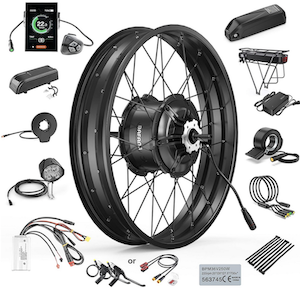
Bafang mid-drive kits are widely respected for their high torque and strong climbing ability. Many models also include:
- LCD displays
- Waterproof wiring
- Integrated controllers
- Optional Bluetooth connectivity (newest versions)
These kits are popular for commuting and electric mountain bikes.
VEVOR (e.g., VEVOR 48V 1000W Front Hub Motor Kit – Throttle feature)

It has stainless steel spokes and alloy rims that can withstand road abuse.
The rare-earth metal magnets built inside the motor allow the medium-wattage motor to produce good power.
Equally useful is the aluminum alloy controller, which ensures a medium-resistance current supply.
AW 26″x1.75″ Rear Hub 48V 1000W
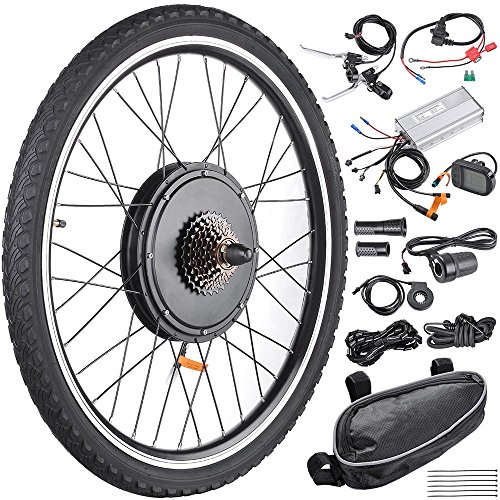
Its brushless hub motor delivers 1000 watts at 48V, enough to reach a top speed of 31mph.
It comes with a dual-mode controller, which lets you switch the kit’s working mode between Hall Effect – for most speeds – and non-Hall Effect – for most ranges.
The controller is smart as well. It will automatically switch to the eco mode if the battery is about to die.
Ebikeling Direct Drive Kit – 500w to 1200w options
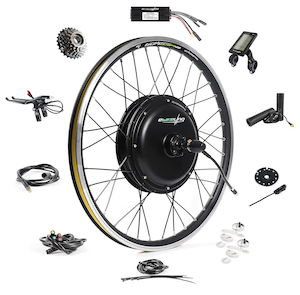
Ebikeling kits are known for their flexibility and compatibility. Many versions include:
- Pedal assist sensors
- Optional LCD displays
- Compatibility with fat tire bikes
This makes them a good option for riders looking for a lot of power and high speed. Please note that the rear hub drive motor is not compliant with the e-bike laws in many countries, unless you ride in private land.
FAQ About Electric Bike Conversion Kits
How Much Do Electric Bike Conversion Kits Cost?
The price of an electric bike conversion kit varies depending on the motor type, battery capacity, and included components.
Typical price ranges:
- Front or rear hub kits: $300 – $500
- Mid-drive kits: $800 – $1,000
- High-power or specialty kits: $1,000+
Battery capacity also affects cost. Larger batteries designed for longer rides increase the price but also extend the bike’s range.
Are electric bike conversion kits legal?
In most countries, conversion kits are legal as long as the motor power and speed limits comply with local regulations. Always check your region’s laws before installing a kit.
General rules of thumb:
- Motor power below 250w
- Cutoff speed maximum at 25 km/h (pedal only). Thorttle cutoff at 6 km/h, then pedalling.
How fast can an electric bike conversion kit go?
Speed depends on the motor power and local regulations. Most kits provide assistance up to 25 km/h (15.5 mph) or 32 km/h (20 mph). However, anything beyong 250w motor output power will go faster and potentially ilegal.
Can any bicycle be converted into an e-bike?
Most bicycles can be converted, including hybrid, commuter, and mountain bikes. However, frame strength, brake quality, and wheel compatibility should always be evaluated.
2026 Updates in Electric Bike Conversion Kit Technology
Electric bike technology evolves quickly, and the conversion kit market has also seen several improvements. These updates focus mainly on smarter electronics, lighter components, and better efficiency.
Smarter tech
Many modern conversion kits now include Bluetooth or app-connected displays. Riders can monitor speed, battery range, ride statistics, and even update firmware through a smartphone.
These smart displays are becoming more common in mid-drive kits and premium hub motor systems.
Easier installation
Manufacturers are also focusing on plug-and-play wiring systems.
Color-coded connectors and waterproof cables now make installation much simpler for riders who want to convert their bikes at home.
Overall, these kits remain simple and minimalist so most riders could contemplate the possibility for going electric.
E-Bike Conversion Kit – Final Thoughts
An conversion kit can be a smart investment for riders who want electric assistance without replacing their entire bike.
The best option depends on your riding style:
- Mid-drive kits for hills and high performance
- Hub motor kits for easy installation and commuting
- Friction drives for simple, budget conversions
When chosen carefully, the right electric bike conversion kit can transform your everyday bicycle into a powerful and efficient transport option, extending your riding range and making cycling more enjoyable.
